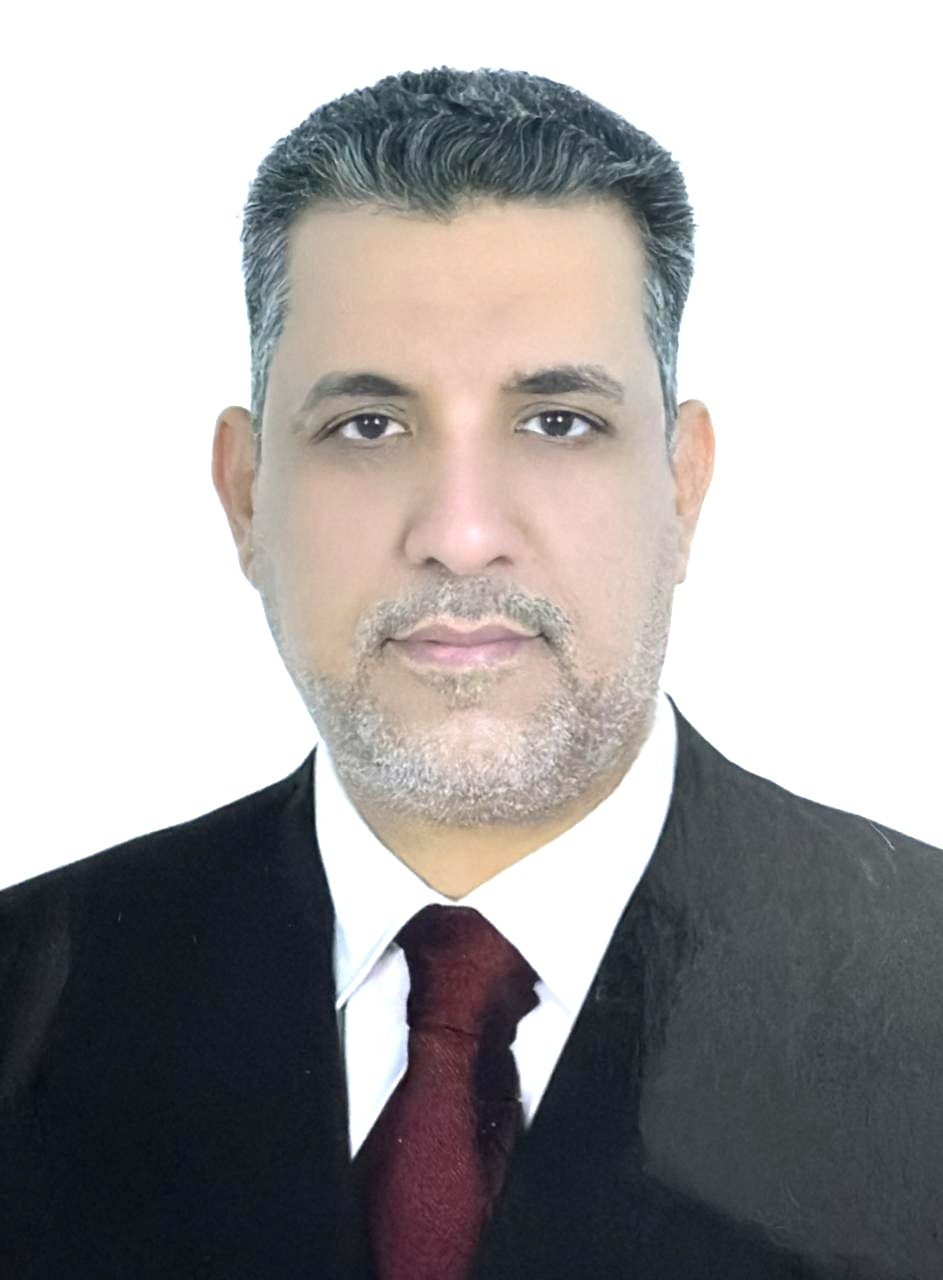
Biography
استاذ في جامعة الفرات الاوسط التقنية بلقب مدرس كان اول تعيين في المعهد التقني كوفة سنه 2006 تدرجت في الوظيفة واكملت دراسة الماجستير من خلال زمالة دراسية في دولة روسيا الاتحادية واكملتها في سنة 2014 حاليا طالب دكتوراهRsearch Interests
- Research Interests (short)UAV-assisted wireless networks (A2G/A2A)5G/6G systems & mmWave propagationAI/ML for channel estimation & resource allocationMIMO/beamforming & RIS-aided linksEnergy-efficient, reliable non-terrestrial networks (UAV–HAPS–satellite)One-liner: UAV communications, 5G/6G, AI-driven channel estimation, mmWave/MIMO/beamforming, RIS, and energy-efficient NTN.
Qualifications
- دبلوم تقنيات كهربائية - جامعة الفرات الاوسط - المعهد التقني كوفة 2001
- بكالوريوس تقنيات هندسة اتصالات -جامعة الفرات الاوسط التقنية - الكلية التقنية النجف 2006
- ماجستير هندسة انظمه اتصالات - جامعة قازان - روسيا الاتحادية 2014
- طالب دكتوراه - جامعة الفرات الاوسط التقنيه - الكلية التقنية النجف - قسم هندسة الاتصالات
Scientific Supervision
- الاشراف على العديد من مشاريع التخرج للطلبة في قسم تقنيات الكهربائية في المعهد التنقي كوفة
Scientific Research
- Optimization of Resource and Bandwidth Allocation in Wireless Networks Performance Analysis using Artificial Intelligence
Abstract
In a man-made reasoning, which is so called artificial intelligence AI has been
effectively utilized in the most recent decades to arranging and allotting the remote
system transfer speed. In a wired system, hubs can watch out for the medium to
perceive how much data transmission is being utilized by the system. As a matter of
fact, this can't be given in the remote systems. Then again, in a remote systems, during
correspondence hubs perhaps will utilize the transmission capacity of neighboring
hubs as a clever procedure to find the necessary transfer speed . Subsequently, the data
transfer capacity utilization of streams and the open assets to a hub are not nearby
ideas, other than it being connected to the neighboring hubs in transporter detecting
range. Current arrangements don't deliver how to perform affirmation control in such a
domain in this way, that the necessary streams in the system don't surpass organize
limit. In this examination, correlation among AI applications will be presented with
different ways to deal with exhibit how the data transmission is shared between hubs
just as the adequacy of using the AI proposed calculation to discover the framework
transfer speed. In other words, this research, will present comparison among AI
applications with other approaches to demonstrate how the bandwidth is shared
between nodes as well as the effectiveness of utilizing the AI proposed algorithm to
find the system bandwidth. 2023
- Evaluation of health hazards due to the Wi-Fi router on humans
Abstract
The purpose of this study is to investigate the negative effects of Wi-Fi routers in houses on human health. As these devices have become an essential part of daily life, they are widely used for communications and the Internet. No house can do without it. The radiation emitted from these routers causes many symptoms, such as heart diseases, sleep disorders, brain tumors, ear hearing problems, male infertility, etc. This study looked at 15 different symptoms that may be caused by the emitted radiation by the routers. A questionnaire was distributed for a large number of medical doctors working in five major hospitals in the city of Najaf, and another for individuals who have routers in their house and who do not. The results showed that Wi-Fi routers have an effect on human health that does not exceed 30%. Individuals with routers have more symptoms than people without Wi-Fi routers. While females are more affected by routers than others. 2021
- Assessment of health effects of cell-phone towers radiation in Najaf on human beings
A survey was conducted to collect information on possible health risks of cell-phone towers in Najaf Governorate, Iraq. Data were obtained from people living near to cell-phone towers. A questionnaire was used to collect information from 600 people and included 20 potentially unspecified health symptoms. In addition to measuring the power density of nearby sites around the towers within a distance of 100 meters. Results of the data analysis indicated that people who live near mobile phone towers within a range of 50 meters and for a long period of time are exposed to some potential health risks., such as (A decline in general health, Fatigue, Headaches, Muscle pain, Nausea), Females are more exposed to these risks than males. The measurement of power density inside homes was within the safe limit recommended by ICNIRP and Bio initiative Report. 2023
- Strategies for Productive Execution of Digital FIR Practical Filtering
Abstract
With the huge development of communications technologies today, digital finite impulse response (FIR) filters have been widely utilized frameworks, waveform handling, and electronic frameworks implementations. The FIR filters impulse response experiences a sharp and unexpected deviation bringing about poor ghostly qualities in the frequency space of the planned channel. This sharp rot in the impulse response of the FIR digital channel is brought about by the low request of the examined channel set to unpredictable and differing upsides of the digital channel coefficients. In this exploration, a creative procedure was contemplated, tried, and implemented utilizing a digital channel compensator to enlighten the transient impact in the impulse response of a FIR channel. The suggested technique will lightly collect a fragmentary qualities to the FIR filter weights so the sudden regression will be limited beyond expanding the need for the filter. This will upgrade the next otherworldly qualities of the planned FIR digital channel and the perfect spectral components would be accomplished utilizing a more honed spectrum dismissal frequency range. The reproduction software has been employed using MatLab2020 Simulink Tool Box © with LPF fifth as well as tenth request digital filter plan. 2023
- Design and simulation of phase looked loop PLL based frequency synthesis
Here research portrays the execution as well as activity highlights for a "Phase-Locked Loop" ("PLL") engineering established frequency synthesizer for clock age also, computerized schemes running. From a programmed design, seeing an entry source frequency FREF=30 MHz, also, the synthesized waveform frequency will be 100 MHz. In the wake of producing the reproduction beside such qualities, one may next alter these values through introducing advanced qualities in the "MATLAB® Command Window", assuming one need to test beside this scheme. This model tells the best way to reproduce a "phase-locked loop (PLL) frequency synthesizer". The scheme duplicates the (fsynFr) source signal frequency using a steady synN/synM, to deliver an integrated wave have a frequency of synFr*synN/synM. A criticism loop keeps up with the synthesized wave frequency on such stage. 2023
- DESIGN AND SIMULATION OF ROBUST DIGITAL VIDEO BROADCASTING CABLE (DVBC) USING QUADRATURE PHASE SHIFT KEYING (QPSK) MODEMS TECHNOLOGY WITHIN GAUSSIAN INTERFERING CHANNEL
Abstract
The main focus of this research is the design and simulation of a cable television DTTB SYSTEM THAT IS viewable in a QPSK demodulator, within a Gaussian noise interference channel. QPSK is the industry standard for encoding video signals. It's possible to find practical issues that prevent streaming. This, I would assume, is partially due to Equipment and encoding inconsistencies. For this research, QPSK has been used for encoding. This encoding will be made use as a part of the Gaussian channel for transmission and response. Adaptive equalization, but digital ones are being included to fix deficiency problems such as digital segregation and interference. Whenever data is comprehensively transmitted forth and back, the model forecasts that it would be possible to increase the transmission quality. In Particular, the model ensured a defined BER performance below 1 percent and provided reasonable throughput when SNR was in the range of 15 to 20 decibels. Broadly, the whole system can be divided into three functional blocks, which are the input and output sections (which are, in simpler terms, termed as communication channels) and the last block, which is the modulator block, and in this case, is the QPSK block. So, in a simple quest for this purpose, the system is designed in such a way as to limit the degradation of the received signal due to the presence of noise and interference in the Gaussian channel. Adaptation, or commonly known as equalization, is also the process of channel estimation, where the channel distortion is compensated for. It has improved in the simulation.
- IoT-Enabled Smart Medicine Container for Expiration Safety and Refill Alerts Using Weight
and RFID/NFC Sensing
Abstract— Medication nonadherence and unsafe home medication practices remain persistent challenges, particularly for patients managing multiple medicines over long periods. In parallel, household surveys show that expired or unnecessary medicines are commonly present in homes, increasing the likelihood of unintentional use when expiry dates are overlooked. This paper proposes a low-cost IoT-enabled medicine container that provides (i) proactive expiration warnings, (ii) remaining-quantity and refill notifications, and
(iii) scheduled dose-time reminders with in-app patient acknowledgement based on weight sensing, with optional RFID/NFC or barcode-based registration to reduce user
burden. The design adopts an edge–cloud architecture: an embedded node acquires and filters sensor readings, estimates remaining doses, detects consumption events, and synchronizes concise state updates to a cloud service that enforces alert policies and delivers notifications to the patient and (optionally) a caregiver. A practical methodology for dose estimation, depletion prediction, and alert triggering is presented, together with an implementation plan for a proof of-concept prototype and evaluation protocol. The proposed
system aims to unify safety (expiry awareness) and availability (refill readiness) in a single home-use workflow with minimal manual interaction.
- Digital-Twin and Ray-Casting-Supervised Surrogate Learning for Accelerated Radio-Map
Generation and UAV-BS Placement Optimization in mmWave Campus Networks
Abstract— Accurate radio-map generation and UAV base station (UAV-BS) placement planning in mmWave bands are strongly affected by site-specific blockage, yet high-fidelity 3D visibility evaluation can be computationally prohibitive at campus scale. This paper presents a digital-twin, ray-casting supervised surrogate-learning framework to accelerate radio map generation and placement optimization for UAV-assisted mmWave networks in a real campus environment. A 3D mesh of the Najaf Technical Institute campus is used to build a visibility-aware ground-truth oracle that determines LoS/NLoS via mesh-based ray casting and computes path loss using a link-budget model (FSPL with an NLoS penalty). Using oracle labeled samples, a ray-free regression surrogate based on Extremely Randomized Trees is trained under group-split evaluation to generalize to unseen UAV placements, achieving MAE = 3.751 dB and RMSE = 5.841 dB on held-out placement
groups. The trained surrogate enables fast screening of candidate UAV locations and supports coverage-driven and cell-edge-driven objectives, followed by Top-K full-grid oracle
verification for reliability. At h = 200 m and γ = 5 dB, the cell edge-optimized placement increases the 5th-percentile rate from 19.29 Mbps (center baseline) to 34.97 Mbps while
maintaining near-saturated coverage (≈ 89.4%). Hierarchical surrogate planning reduces end-to-end search time from 600.36 s (wide surrogate grid-search) to 170.76 s (planning +
oracle verification), and cuts expensive full-grid oracle evaluations by 391× via Top-K verification. These results demonstrate that digital-twin supervision coupled with surrogate acceleration provides a practical pathway for campus-scale mmWave UAV-BS planning with oracle-verified performance guarantees.
- Slice-Aware AoI Control for UAV-Assisted 5G and Beyond-5G Waste Hotspot Mapping Using Kernel Fused Density Updates
Abstract— Long-lived waste (e.g., plastics and slow degrading residues) often accumulates into spatial hotspots, yet periodic IoT reporting can leave hotspot knowledge stale
at the time municipal decisions are made. This paper proposes a slice-aware Age-of-Information (AoI) framework for UAV-assisted waste hotspot mapping that explicitly targets actionable freshness at the server. A UAV samples a waste-density proxy over a gridded area and generates an update only when either server-side staleness or measurement innovation exceeds a threshold, thereby avoiding redundant transmissions while preserving
informative reports. Each generated update is then mapped to one of two logical service classes consistent with 5G/Beyond-5G slicing: hotspot-critical packets are prioritized on a URLLC-oriented slice, whereas routine traffic uses a routine mMTC/eMBB-oriented slice. At the server, sparse samples are fused through kernel-footprint aggregation to maintain a continuous waste-density field and support density- and freshness-driven municipal alerts. In a system-level simulation with slice-dependent delay, delivery, and energy haracteristics, the proposed method improves end-of-run coverage from 0.6269 to 0.9443 and reduces
RMSE from 0.1692 to 0.1328 over the full grid (0.3814 to 0.2826 over hotspots). It also reduces mean AoI from 547.27 s to 405.62 s and hotspot AoI P95 from 1010.0 s to 756.5 s, at the cost of higher communication energy. These results indicate that selective slice-ware AoI control can substantially reduce hotspot staleness and improve map fidelity in UAV-assisted waste monitoring.
- Enhancement of Bit Rates for Deep Learning Channel Estimation in 5G Wireless Communication
Abstract : Deep learning-based methods are increasingly being explored in fifth-generation (5G)
communications, despite the proven reliability of handcrafted signal-processing blocks
and coding schemes. To address real-time interference cancellation without introducing
feedback loops between the modulator and demodulator, we suggest a neural-network
driven baseband processing framework that seamlessly integrates with conventional
digital signal processing (DSP) algorithms. This architecture is particularly well suited to
low-latency, high-data-rate applications such as autonomous systems and augmented
reality. Unlike prior work that applies reinforcement learning in the control layer for
interference management, our approach esmbeds a convolutional neural-network auto
encoder directly within the physical layer to perform what we term “Deep Interference
Cancellation.” When applied to quadrature amplitude modulation–orthogonal frequency
division multiplexing (QAM-OFDM) signals, this model achieves up to a 15% reduction
in symbol-error rate (SER). We also evaluate the hardware implications of our design
covering latency, power consumption, memory footprint, and silicon area-and demonstrate
its practical viability. Finally, through extensive simulations, we show that our deep
learning channel estimator can mitigate noise and interference to enhance effective bit
rates. In particular, we attain SERs as low as 1% at a signal-to-noise ratio (SNR) of 20 dB,
surpassing comparable industrial solutions in both performance and implementation
complexity.